How story point voting works
How story point voting works in planning poker: private cards, shared reveal, discussion of outliers, and when to revote or split—without treating points like hours.
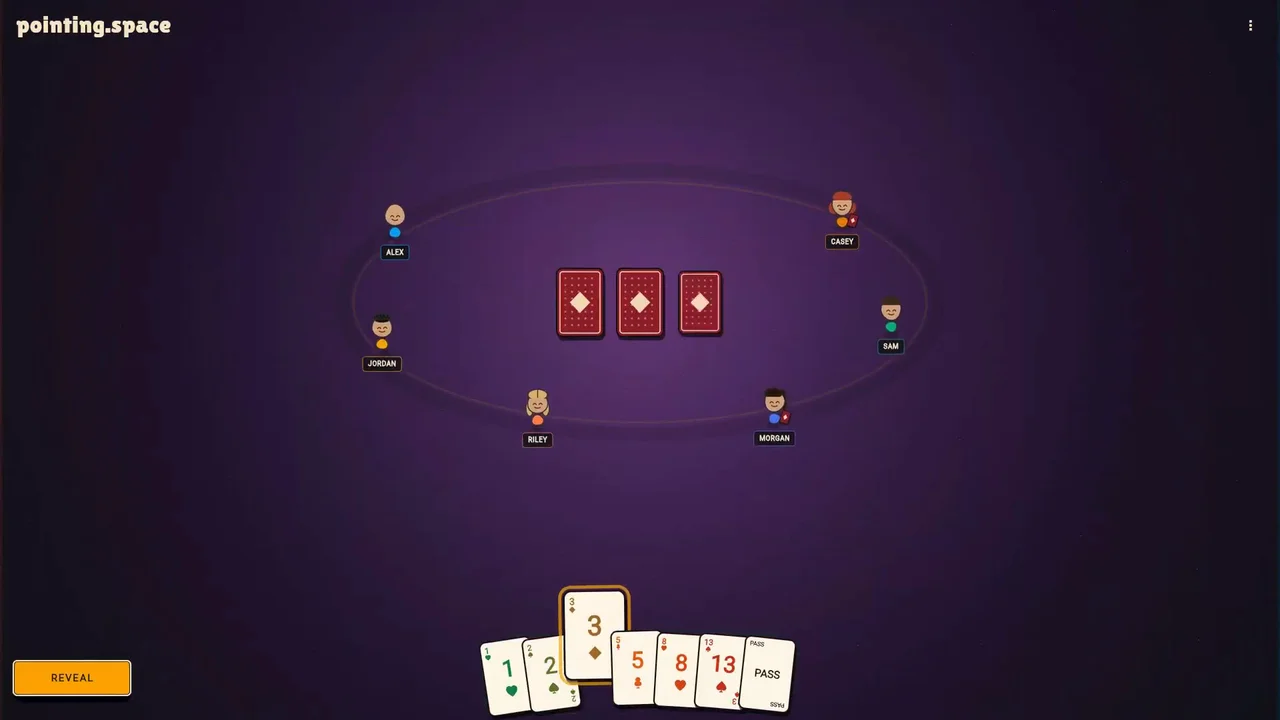
Story point voting in plain terms
Story point voting is how a team turns “how hard is this?” into a shared number without one person deciding alone.
In planning poker, everyone picks a card in private, then you reveal together. The vote is relative effort and uncertainty—not a promise of hours on a timesheet.
The reveal is the product. Agreement after a quiet vote beats a loud room that anchors on the first opinion.
What a story point actually measures
A point is a team-calibrated unit of relative size: complexity, volume of work, and risk bundled into one card.
Two stories with the same points should feel similar in overall effort for this team—not identical in calendar days for every person.
That is why mapping points strictly to hours often breaks the practice. You re-create time arguments instead of comparing work.
The voting loop, hand by hand
1. Name the work. Put the story title or ticket ID on the hand so everyone estimates the same thing.
2. Confirm the deck. Fibonacci is the default for most engineering teams; T-shirts suit mixed audiences; working days are for short, explicit time boxes.
3. Vote privately. No calling numbers out loud, no peeking, no senior engineer “thinking aloud” first.
4. Reveal together. Look at the spread, not only the mode.
5. Talk only when it matters. Wide gaps mean assumptions differ—testing, migrations, edge cases, dependencies.
6. Decide, revote once, or split. Then log the number and move on.
How to read the cards after reveal
Tight cluster (everyone on 3 or 5): short check that you mean the same scope, agree, next hand.
Small spread (3 vs 5): usually one person included something the others skipped. Align scope, pick one number.
Wide spread (2 vs 13): stop averaging. Ask what each high and low vote assumed. Often the story is two stories, or readiness is weak.
Question / break / infinite cards (if your deck has them): the room is saying “not ready” or “too big”—treat that as a signal, not a failure.
Who votes and who facilitates
People who will do the work should cast cards. They carry the implementation risk.
Scrum masters, BAs, and managers often facilitate: set the topic, keep pace, run reveal—without anchoring the estimate. Facilitator mode exists for that reason.
Product partners clarify intent and acceptance criteria. They should not force a point value the builders do not believe.
Common failure modes
Open discussion before the first vote. You get one estimate dressed as consensus.
Averaging wild spreads. “Five and twenty becomes twelve” hides missing scope.
Estimating unready tickets. Voting becomes discovery theater.
Switching decks mid-session. Calibration dies; the meeting becomes a scale debate.
Treating velocity as a target. Points are for planning capacity trends—not a performance scoreboard.
Run the vote online without friction
Remote and hybrid teams need the same private-card ritual as a physical table. A browser room keeps everyone on one hand, one deck, one reveal.
Pointing Space is free online planning poker for that loop: share a link, paste the ticket, vote privately, reveal, next hand—no install and no account required to start.
New to the practice? Read what is planning poker. Need a full agenda? See how to run a story point estimation meeting. Choosing a scale? Compare Fibonacci vs T-shirt sizes.
FAQ
How does story point voting work in planning poker?
Everyone selects a card privately on a shared scale, then reveals together. You discuss outliers, align assumptions, agree a number or split the work, and log the result.
Should story points equal hours?
No. Story points are relative effort and uncertainty for the team—not a timesheet conversion. Hour mappings usually restart the same debates planning poker was meant to avoid.
What if the team cannot agree after one revote?
Do not force a fake average. Capture the differing assumptions, split the story, or schedule a spike. Consensus without shared scope helps nobody in sprint planning.
Who should vote on story points?
The people doing the work should vote. Facilitators can guide the room without casting a card that anchors everyone else.
Related guides
Want to try it live? Create a free planning poker room on Pointing Space.